
Network Function Virtualization Market Forecast Report 2026–2036: USD 11.1 Billion Valuation
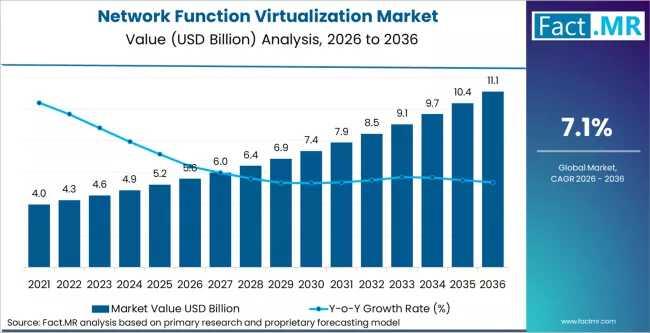
The global infrastructure landscape is undergoing a fundamental shift as the Network Function Virtualization (NFV) market prepares for a decade of sustained expansion. Valued at USD 5.3 billion in 2025, the sector is projected to climb to USD 5.6 billion in 2026 before nearly doubling to USD 11.1 billion by 2036, according to the latest strategic analysis by Fact.MR.
Representing a compound annual growth rate (CAGR) of 7.1%, this trajectory is fueled by a ""mandatory migration"" to 5G Standalone (SA) core networks and the rapid replacement of proprietary hardware with agile, software-defined alternatives.
Get Access Report Sample https://www.factmr.com/connectus/sample?flag=S&rep_id=1327
The Catalyst: 5G Standalone and the Death of ""Black Box"" Hardware
The primary engine behind this growth is the transition of 5G core functions to cloud-native virtualized environments. Unlike early 5G deployments that relied on 4G infrastructure, 5G Standalone requires the decoupling of network functions from underlying hardware to achieve promised latencies and speeds.
""The industry has reached a tipping point where traditional hardware appliances are no longer viable for the scale of modern data traffic,"" notes Shambhu Nath Jha, Principal Consultant at Fact.MR. ""Decision-makers are prioritizing NFV to unlock network slicing and AI-automated orchestration-capabilities that are essential for monetizing 5G investments.""
Key Market Dynamics and Emerging Trends
The shift toward virtualized environments is creating an absolute dollar opportunity of USD 5.5 billion over the next ten years. Several critical trends are defining this evolution:
Enterprise SD-WAN Adoption: Beyond telecom, sectors like BFSI and Healthcare are aggressively adopting SD-WAN and zero-trust security, replacing physical firewalls with Virtual Network Functions (VNFs).
AI-Driven Orchestration: New categories of virtualized functions are emerging, utilizing AI to automate network lifecycles and reduce the soaring operational costs associated with manual configuration.
Regulatory Impetus: Mandates like the EU's NIS2 Directive are forcing a move toward sovereign, virtualized security platforms that offer greater transparency and rapid patch management compared to ""black box"" legacy gear.
Regional Outlook: China and India Lead the Charge
The Asia-Pacific region remains the global powerhouse for NFV deployment, led by massive infrastructure projects.
China (7.8% CAGR): With China Mobile and China Telecom expanding large-scale 5G SA networks, China continues to be the fastest-growing market.
India (7.0% CAGR): Driven by Reliance Jio and Airtel's nationwide rollouts, alongside the government's BharatNet 2.0 initiative, India is a critical hub for NFV software development.
North America (5.9% CAGR): The United States remains the largest revenue market, centered on Open RAN innovation and significant federal investment via the NTIA Public Wireless Supply Chain Innovation Fund.
Europe: Germany (6.5% CAGR) and France (6.1% CAGR) are seeing high adoption rates as Tier-1 operators like Deutsche Telekom and Orange modernize their cores to meet stringent new network resilience codes.
Competitive Landscape: A Multi-Vendor Reality
The market is currently characterized by a mix of established telecom giants and agile software providers. Key players shaping the industry include:
Cisco, Huawei, Broadcom, Ericsson, Juniper Networks, AT&T, Nokia, F5 Networks, HPE, Citrix, Riverbed Technology, VMware, Verizon, IBM, and Amdocs.
While major vendors like Ericsson and Nokia maintain dominance in 5G core contracts, the rise of Open RAN and multi-vendor NFV architectures is allowing specialized software players to capture significant share in the enterprise and security segments.
Strategic Outlook for Investors and Executives
As the market moves toward 2036, the focus for stakeholders is shifting from basic virtualization to advanced orchestration (MANO). Integration complexity remains a moderate restraint; however, the shortage of NFV-certified talent is driving a surge in the Services and Managed Service segments, which provide the expertise necessary to bridge the gap between legacy environments and cloud-native futures.
For organizations looking to navigate the next decade of connectivity, the message is clear: the future of the network is software-defined, automated, and decoupled from the constraints of physical hardware.
Browse Full Report : https://www.factmr.com/report/1327/nfv-market
To View Related Report
Network Access Control Market https://www.factmr.com/report/4061/network-access-control-market
Network Video Recorder Nvr Market https://www.factmr.com/report/network-video-recorder-nvr-market
Network Performance Monitoring Market https://www.factmr.com/report/network-performance-monitoring-market
Network Analyzer Market https://www.factmr.com/report/network-analyzer-market
Ai In Networking And Edge Platform Imaging Market https://www.factmr.com/report/ai-in-networking-and-edge-platform-imaging-market
- Contact Us -
11140 Rockville Pike, Suite 400, Rockville,
MD 20852, United States
Tel: +1 (628) 251-1583 | sales@factmr.com
About Fact.MR
Fact.MR is a global market research and consulting firm, trusted by Fortune 500 companies and emerging businesses for reliable insights and strategic intelligence. With a presence across the U.S., UK, India, and Dubai, we deliver data-driven research and tailored consulting solutions across 30+ industries and 1,000+ markets. Backed by deep expertise and advanced analytics, Fact.MR helps organizations uncover opportunities, reduce risks, and make informed decisions for sustainable growth.

 English
 Arabic
 Spanish
 Portuguese
 Deutsch
 Turkish
 Dutch
Dutch
 Italiano
 Russian
 Romaian
 Portuguese (Brazil)
 Greek
Greek