
Global Agricultural Adjuvant Market Trends and Crop Protection Outlook to 2036
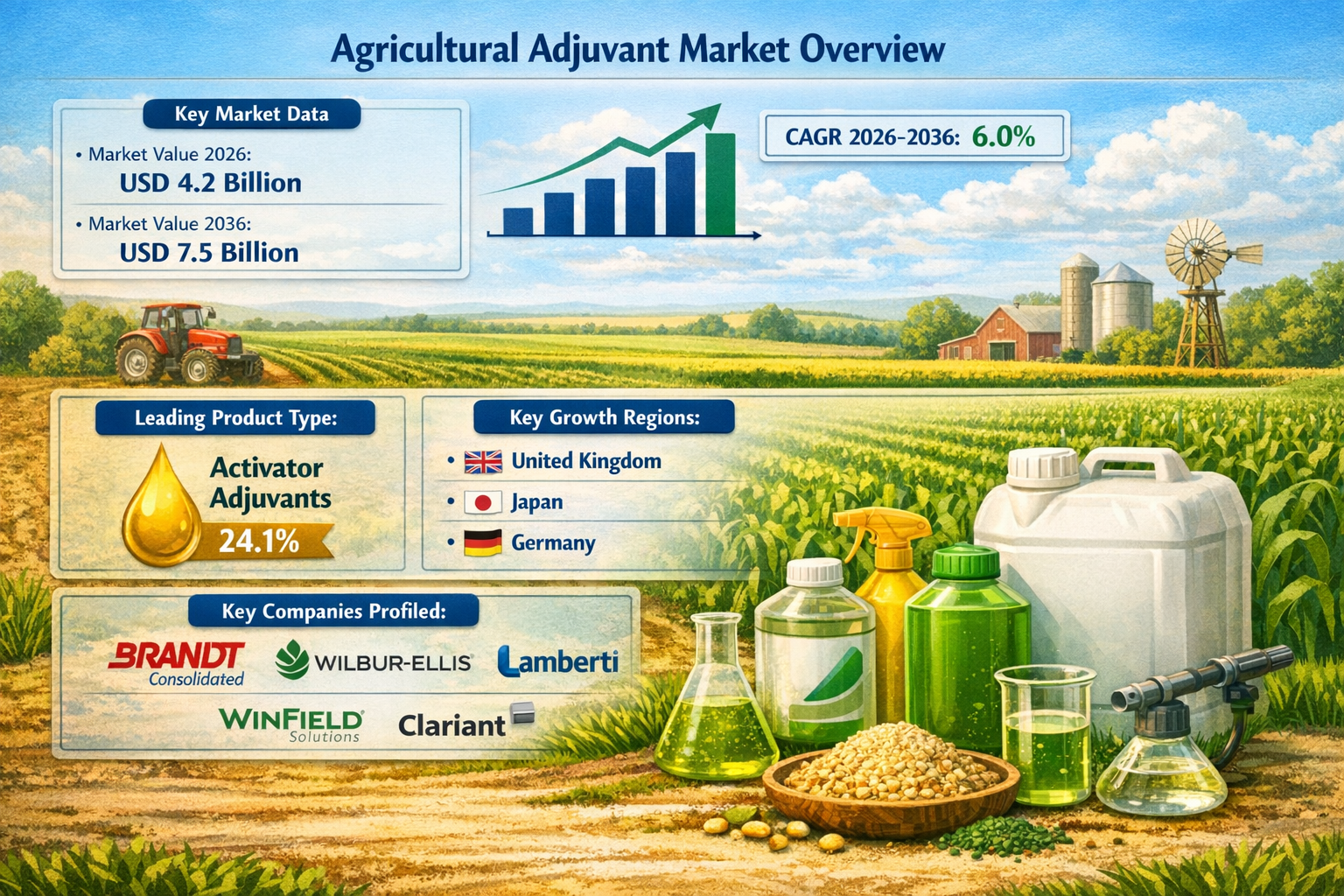
Agricultural Adjuvant Market Outlook 2026–2036
The global Agricultural Adjuvant Market is entering a transformative phase as modern farming practices increasingly prioritize efficiency, sustainability, and cost optimization. With agricultural productivity under pressure from climate variability, soil degradation, and rising input costs, growers are turning to advanced crop protection technologies to maximize output.
According to industry estimates, the agricultural adjuvant industry valuation is projected to reach USD 4.2 billion in 2026. Continued adoption of precision agriculture and improved pesticide performance is expected to drive the market at a compound annual growth rate (CAGR) of 6.0% between 2026 and 2036, pushing the industry value beyond USD 7.5 billion by 2036.
Agricultural adjuvants—substances added to pesticide formulations—play a crucial role in improving the performance, stability, and efficiency of crop protection chemicals. As the agriculture sector shifts toward sustainable and input-efficient farming systems, adjuvants are becoming an essential component in modern crop management strategies.
Key Drivers Accelerating the Agricultural Adjuvant Market
The demand for agricultural adjuvants is being fueled by multiple structural trends reshaping the global farming landscape.
- Growing demand for crop protection efficiency
Farmers are increasingly using adjuvants to improve pesticide spreading, penetration, and retention on plant surfaces. This improves the effectiveness of herbicides, fungicides, and insecticides while reducing chemical wastage. - Rapid adoption of precision agriculture technologies
Precision farming tools such as GPS-guided sprayers, drone-based pesticide applications, and smart irrigation systems require optimized formulations. Adjuvants help ensure uniform spray coverage and better product performance. - Rising global food demand
A growing global population is increasing pressure on farmers to maximize crop yields. Adjuvants help enhance pesticide performance and nutrient absorption, supporting higher productivity. - Increasing regulatory pressure on pesticide use
Stricter environmental regulations across regions are encouraging farmers to reduce chemical volumes while maintaining crop protection efficiency. Adjuvants enable lower pesticide dosages while maintaining effectiveness. - Expansion of sustainable agriculture practices
Policy-driven emphasis on sustainable farming is accelerating the adoption of environmentally compatible crop inputs, including biodegradable and bio-based adjuvants.
Understanding Agricultural Adjuvants and Their Role in Modern Farming
Agricultural adjuvants are substances added to pesticide spray solutions to enhance the performance of agrochemicals. These additives improve the physical and chemical properties of spray mixtures, ensuring better coverage and absorption.
Major functional benefits include:
- Improved pesticide spreading on leaf surfaces
• Enhanced penetration through plant cuticles
• Reduced spray drift and evaporation losses
• Improved compatibility between tank mix components
• Increased stability and effectiveness of pesticide formulations
By optimizing pesticide application, adjuvants help farmers reduce chemical usage while improving crop protection outcomes, making them an important component of sustainable agriculture strategies.
Market Segmentation Trends Shaping Industry Demand
The agricultural adjuvant market is evolving with innovations across multiple product categories.
- Activator adjuvants
These enhance pesticide absorption and biological activity. Surfactants and oil-based adjuvants are among the most widely used types. - Utility adjuvants
These improve spray application characteristics such as drift control, water conditioning, and foam reduction. - Oil-based adjuvants
Petroleum oils and vegetable oils help improve pesticide penetration and performance. - Non-ionic surfactants
These improve spreading and wetting of spray droplets on crop surfaces. - Drift control agents
These help reduce pesticide spray drift, supporting regulatory compliance and environmental protection.
Regional Outlook for Agricultural Adjuvant Market Growth
Demand for agricultural adjuvants varies across regions depending on farming practices, regulatory frameworks, and crop types.
- North America
The region remains a leading market due to widespread adoption of precision agriculture technologies and advanced crop protection strategies. - Europe
Strict environmental regulations and increasing demand for sustainable farming inputs are driving the adoption of eco-friendly adjuvants. - Asia-Pacific
Rapid agricultural modernization and rising food demand are creating significant growth opportunities in countries such as India, China, and Southeast Asia. - Latin America
Expanding soybean, corn, and sugarcane cultivation is driving the use of crop protection chemicals and supporting adjuvant demand.
👉 Get Access to the Report Sample:
Technological Innovations in Agricultural Adjuvants
Innovation is playing a critical role in the evolution of the agricultural adjuvant market.
Emerging developments include:
- Bio-based and biodegradable adjuvant formulations
• Advanced surfactant technologies for improved spray efficiency
• Nano-enabled adjuvant solutions for better absorption
• Adjuvants designed specifically for drone-based pesticide applications
• Customized tank-mix compatibility solutions for modern agrochemical formulations
These innovations are enabling more targeted and efficient pesticide applications while reducing environmental impact.
Sustainability Trends Influencing the Market
Sustainability is becoming a defining factor in the future of agricultural inputs.
Key sustainability trends shaping the market include:
- Adoption of environmentally friendly adjuvant formulations
• Reduction of pesticide runoff and spray drift
• Increased compatibility with biological crop protection products
• Improved water-use efficiency in agricultural spraying systems
• Integration with regenerative agriculture practices
Governments and regulatory bodies worldwide are promoting these practices to ensure long-term agricultural productivity and ecosystem protection.
Future Outlook for the Agricultural Adjuvant Industry
The agricultural adjuvant market is expected to witness steady expansion over the next decade as farmers seek smarter ways to maximize crop productivity.
Key future trends include:
- Rising integration of adjuvants with precision agriculture platforms
• Increasing demand for bio-based agricultural inputs
• Expansion of drone and autonomous spraying technologies
• Greater focus on input optimization in crop protection programs
• Growing investments in sustainable agriculture solutions
With industry valuation expected to surpass USD 7.5 billion by 2036, agricultural adjuvants will remain a vital tool for improving pesticide efficiency, reducing environmental impact, and supporting global food security.
Why FMI: https://www.futuremarketinsights.com/why-fmi
About Future Market Insights (FMI)
Future Market Insights (FMI) is a leading provider of market intelligence and consulting services, serving clients in over 150 countries. Headquartered in Delaware, USA, with a global delivery center in India and offices in the UK and UAE, FMI delivers actionable insights to businesses across industries including automotive, technology, consumer products, manufacturing, energy, and chemicals.
An ESOMAR-certified research organization, FMI provides custom and syndicated market reports and consulting services, supporting both Fortune 1,000 companies and SMEs. Its team of 300+ experienced analysts ensures credible, data-driven insights to help clients navigate global markets and identify growth opportunities.
For Press & Corporate Inquiries
Rahul Singh
AVP - Marketing and Growth Strategy
Future Market Insights, Inc.
+91 8600020075
For Sales - sales@futuremarketinsights.com

 English
 Arabic
 French
 Spanish
 Portuguese
 Deutsch
 Turkish
 Italiano
 Russian
 Romaian
 Portuguese (Brazil)
 Greek
Greek