
1 Dirham Hair Transplant: Seamless Coverage for Sparse Areas
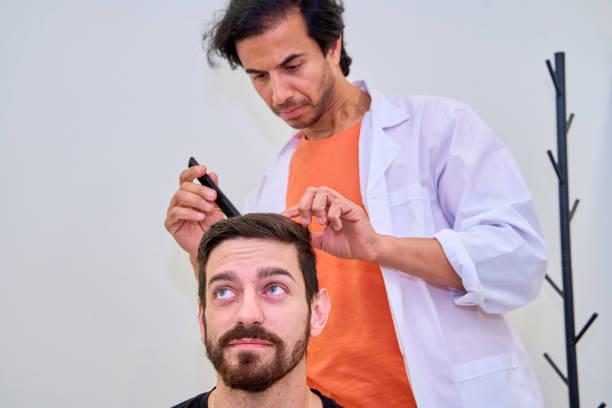
The most frustrating stage of hair loss is often the "in-between" phase—where hair isn't completely gone, but "sparse areas" make the scalp clearly visible under bright office lights or when wet. Patients in this position often feel that standard transplants are "too much," yet they are tired of using thickening fibers or creative styling to hide the gaps. The primary concern here is "shock loss": the fear that a transplant might damage the healthy hair still remaining in those sparse zones.
A 1 Dirham Hair Transplant in Dubai offers a clinically precise solution for these thinning landscapes. By utilizing a high-volume pricing model, patients can afford the 2,500 to 4,000 grafts needed to "interweave" new follicles between existing ones. This strategy creates seamless, opaque coverage that restores the appearance of a full head of hair without the financial burden of a traditional "luxury" price tag.
How Do We Achieve Seamless Coverage in Sparse Zones?
In clinical settings, we observe that filling in sparse areas requires more finesse than a standard "bald spot" fill. The goal is to increase density without traumatizing the neighboring native hair.
-
High-Magnification Implantation: Surgeons use specialized loops to see between existing hairs, ensuring new grafts are placed in the empty spaces with "micro-precision."
-
Depth Control: By carefully calibrating the depth of each incision, we protect the roots of your original hair.
-
Follicle Grouping: We use a mix of "multi-hair" units for bulk density and "single-hair" units to blend the edges, preventing any visible "borders" between old and new hair.
-
DHI (Direct Hair Implantation) Option: This technique is often preferred for sparse areas as it allows for placement without shaving the entire recipient site, making the "seamless" transition even more discreet.
Safety and Suitability: Is This Plan Right for Thinning Hair?
Who is the ideal candidate for "filling in" sparse areas?
The ideal candidate is someone with "diffuse thinning" but stable donor hair. If the sparse areas are caused by active, inflammatory hair loss (like Alopecia Areata), surgery is not the answer. We first ensure the hair loss is "androgenetic" (pattern-based) and stable.
Based on post-procedure follow-ups, we prioritize clinical safety through:
-
Densitometry Analysis: We measure exactly how many hairs you have per square centimeter to determine the "safe" number of grafts we can add without overcrowding the skin.
-
Blood Flow Evaluation: Sparse areas often have healthy blood flow, which supports a high graft survival rate (often exceeding 95%).
-
Future Mapping: We discuss how your hair loss might progress so that our "fill-in" work today doesn't look like an isolated "island" in five years.
Actual Pain Levels: The Sensation of Increasing Density
Does it feel different to have grafts placed between existing hair?
The sensory experience is nearly identical to a standard transplant. The primary sensation is one of "tightness" rather than pain, managed entirely through local anesthesia.
-
The Numbing (Minutes 1–10): A few quick stings as the anesthetic is applied. This is the only part of the day most patients describe as "uncomfortable" (3/10 on the pain scale).
-
The "Tapping" Phase (Hours 3–8): As we interweave grafts into the sparse areas, you will feel a rhythmic tapping. Many patients find the repetitive nature of this phase allows them to drift in and out of sleep.
-
The Post-Op "Fullness": For the first 24 hours, your scalp will feel heavy, as if you are wearing a headband that is slightly too tight.
"I had enough hair to look okay from the front, but the top was getting see-through. I was worried about the pain, but after the numbing, I just sat there and listened to an audiobook. The recovery was a breeze." — Faisal
Realistic Recovery: The 14-Day Seamless Healing
Because we are working between existing hairs, the "crusting" or scabbing phase can feel a bit more hidden, but it still requires dedicated care.
When will the "see-through" look finally disappear?
| Timeline | Clinical Milestone | Visual Expectation |
| Day 1–3 | Grafts are "locking" in. | Mild pinkness; original hair may look a bit flat. |
| Day 7 | Healing is well underway. | Tiny scabs are tucked between your existing hairs. |
| Day 10 | The "Golden Wash." | Scabs shed; the scalp looks significantly "fuller." |
| Month 4 | The New Growth. | New hairs begin to "bulk up" the sparse areas. |
What Feels Surprisingly Easy During Treatment?
-
The Discretion: If you have existing hair that is 2-3 inches long, it is surprisingly easy to "camouflage" the transplant site during the first week of healing.
-
The Pain Management: Most patients are surprised that they don't need any painkillers after the second night.
-
The "Instant" Gratification: Seeing the sparse areas filled with dark "stubble" on Day 1 provides an immediate visual of how you will look once the hair fully matures.
"The first wash at the clinic was so much easier than I thought. I was scared I’d lose grafts, but they showed me exactly how to do it. By day 10, the scabs were gone and I felt like a new man." — Hamad
Common Questions: SPARSE AREAS & SEAMLESS COVERAGE
Will a 1 Dirham transplant cause my existing hair to fall out?
This is called "Shock Loss." While a few native hairs may shed due to the "stress" of surgery, they almost always grow back alongside the new grafts within 3 to 4 months.
How do I know how many grafts I need for "seamless" coverage?
During your consultation, we use a digital densitometer to map your "hairs per cm²." We then calculate the exact number of grafts needed to reach "visual density" (usually 40-50 grafts/cm²).
Can I style my hair normally during recovery?
You must avoid styling products, hair dryers, and harsh brushing for 4 weeks. After that, you can style your new, thicker hair however you like.
Is the 1 Dirham price applicable for "fill-in" work?
Yes. At Tajmeels Clinic, our 1 Dirham Hair Transplant in Dubai is perfectly suited for filling sparse areas, as it allows you to get the high graft count required for true opacity at a predictable, transparent price.
Why Choose Tajmeels Clinic?
At Tajmeels Clinic, we specialize in the art of "Invisible Restoration." Our 1 Dirham Hair Transplant in Dubai is the ideal solution for transforming sparse areas into a seamless, thick canopy of hair. We combine high-magnification Sapphire FUE and DHI techniques to ensure every graft is placed with clinical precision. Our goal is to give you a result that is so natural, the only thing people will notice is that you look younger and more confident.

 English
 Arabic
 French
 Spanish
 Portuguese
 Deutsch
 Dutch
Dutch
 Italiano
 Russian
 Romaian
 Portuguese (Brazil)
 Greek
Greek