
Hair Transplant Abu Dhabi for Crown Baldness: Proven Solutions
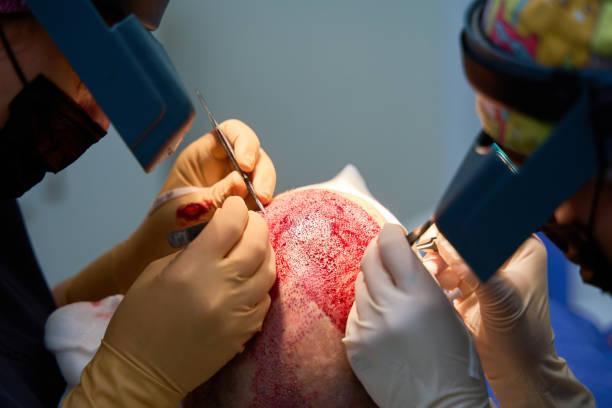
Restoring the crown (the vertex) is widely considered the "ultimate test" for a hair transplant surgeon. Unlike the relatively linear growth of a hairline, the crown follows a complex, circular "whorl" or spiral pattern. In the context of a hair transplant Abu Dhabi, treating crown baldness requires more than just density; it requires a mathematical replication of the scalp's unique geometry. In 2026, advanced crown restoration has become a specialized field, utilizing higher graft counts and specific angulation to ensure that the "billboard effect"—where the scalp is visible under direct overhead lighting—is effectively eliminated.
At the clinical level, success in the crown is heavily dependent on "Future-Proofing." Because crown hair loss is often progressive, our 2026 protocols prioritize preserving a donor reserve for potential touch-ups as you age.
The Geometry of the Vertex Spiral
Why is crown restoration more complex than a hairline transplant?
The crown is the highest point of the scalp, meaning it is exposed to light from every angle. In clinical settings, we observe that even a high-density transplant can look "thin" if the spiral pattern isn't perfectly mimicked.
2026 Crown Restoration Pillars:
-
The "Whorl" Replication: Every graft must be placed in a radial, clockwise, or counter-clockwise pattern that matches your original hair flow.
-
Graft Volume: The crown has a larger surface area than the hairline. While a hairline may need 1,500 grafts, a mid-to-large crown often requires 2,500 to 3,500 grafts to achieve visual "opacity."
-
Multi-Unit Loading: We prioritize "triple" and "quadruple" hair grafts for the crown. These larger units provide the "shingling" effect needed to cover the scalp surface area effectively.
-
Vascular Optimization: The crown has slightly less blood flow than the forehead. In 2026, we utilize Acell or PRP (Platelet-Rich Plasma) during the procedure to "supercharge" the blood supply to the vertex.
The Patient Experience: Sensory Walkthrough
What are the sensations of a crown procedure and its recovery?
A crown transplant is typically a longer session due to the higher graft count. You will be spending more time in a face-down or side-lying position.
-
During the Procedure: You will feel a repetitive "rhythmic tapping" at the top of your head. Because the crown skin is slightly thicker than the forehead, you may feel more "pressure" but zero sharp pain due to our 2026 local anesthesia protocols.
-
The "Weighty" Sensation: For the first 3 days, the back of your head will feel "heavy" and "full." This is normal as the scalp manages the internal fluids used during surgery.
-
The Growth Lag: Based on post-procedure follow-ups, patients should expect the crown to grow slower than the front. You might not see significant "stubble" until month 5 or 6, whereas the hairline sprouts by month 4.
-
The Final "Fill": Around month 14 to 16, you will feel the hair finally "interlock." This is the sensation of the spiral pattern maturing and providing full coverage.
Crown Recovery: The 15-Month Timeline
| Stage | What to Expect (Crown Specific) | 2026 Clinical Goal |
| Days 1–7 | Tenderness & fine scabbing | No infection / 100% graft anchor |
| Months 1–3 | Intense "Shock Loss" (Shedding) | Follicular "Reset" Phase |
| Months 5–8 | Fine, "baby-hair" texture | 30–50% visible coverage |
| Months 12–15 | Thickening of the hair shaft | 80–90% Mature density |
| Month 18 | The "Peak" result | Full scalp opacity |
Clinical Insights on Results
"I didn't realize how bald my crown was until I saw a photo from behind. The surgery took about 7 hours because they were so careful with the 'swirl.' It took a long time to grow—almost a year—but now the 'hole' at the back of my head is completely gone." — Fahad
"The doctors warned me the crown grows slower than the front. They were right. At 6 months, I was worried, but by month 12, it suddenly 'closed up.' The spiral looks so natural that my barber didn't even know I'd had work done." — Marc
Frequently Asked Questions
Why does the crown take longer to grow than the hairline?
The crown has a slightly lower metabolic rate and blood supply compared to the frontal scalp. In 2026, we tell patients to add 3 months to their expectations; if the hairline looks good at 9 months, the crown will look its best at 12–15 months.
Can I fix my hairline and crown in one session?
Yes, provided your donor area is strong enough. This is called a "Mega-Session." We typically use 2,000 grafts for the front and 2,000 for the crown, though this requires a 7–9 hour clinical day.
Will I need a second session for the crown?
Because the crown is a "billboard" for light, some patients opt for a second, smaller "density boost" session 18 months later to achieve 100% opacity, especially if their hair is very fine.
Is crown baldness permanent after a transplant?
The transplanted hair is permanent. However, the native hair surrounding the transplant can still thin. We often recommend a 2026 maintenance plan (like Minoxidil or Finasteride) to protect the surrounding area.
Why Choose Tajmeels Clinic
At Tajmeels Clinic, we treat the crown as a work of "optical architecture." Our approach to a hair transplant in Abu Dhabi utilizes 2026's most refined DHI and Sapphire FUE tools to ensure your vertex spiral is restored with surgical precision and artistic soul.
Our male and female-led specialist teams are experts in managing large-volume crown cases, ensuring maximum density while protecting your donor area for the future. We provide a private, luxury environment where your transformation is supported by 2026’s highest clinical standards. We are dedicated to providing a clinical experience that leaves you with a profoundly clear, naturally dense, and expertly managed head of hair.

 English
 Arabic
 French
 Spanish
 Portuguese
 Turkish
 Dutch
Dutch
 Italiano
 Russian
 Romaian
 Portuguese (Brazil)
 Greek
Greek