
Patentable and Non Patentable Inventions: A Complete Guide
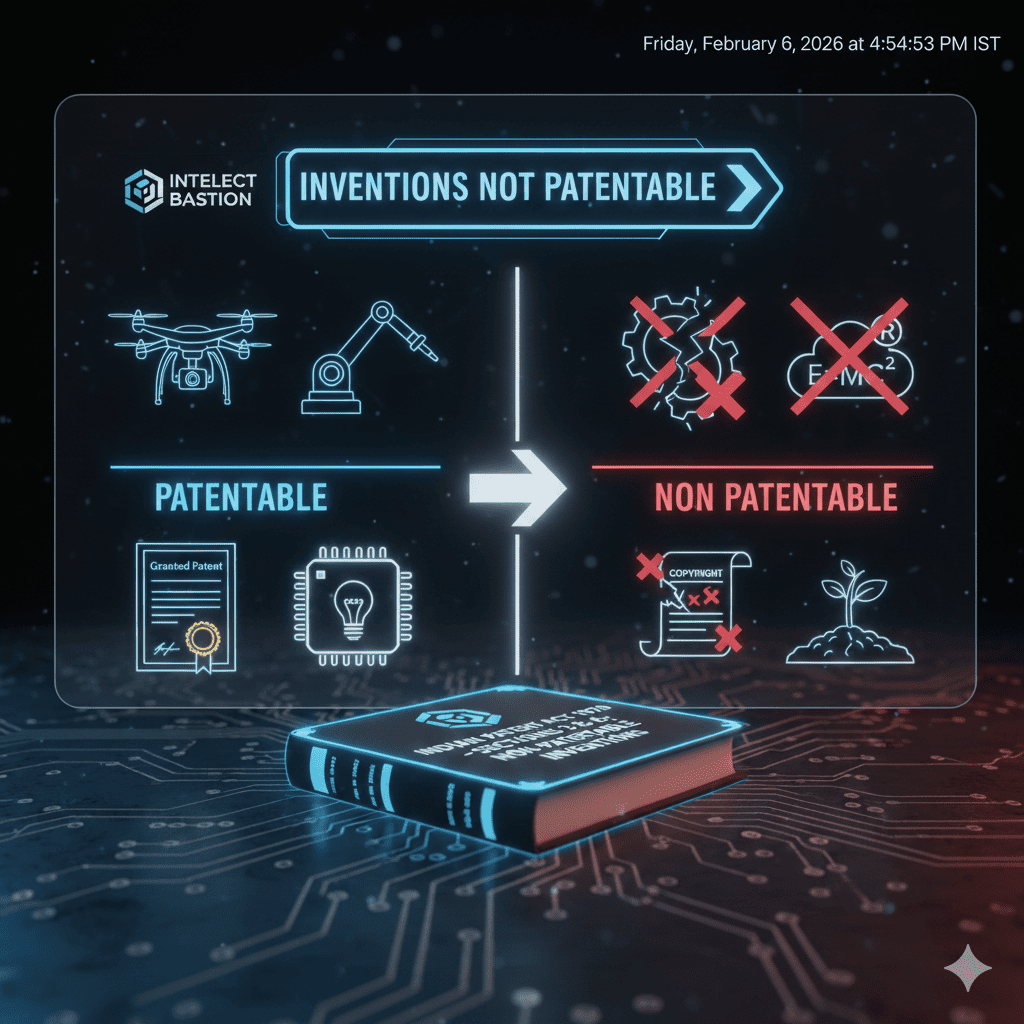
Navigating the Boundaries of Innovation: Understanding Patentable and Non-Patentable Inventions
In the modern age of rapid technological evolution, the race to protect intellectual property (IP) has never been more intense. For inventors and businesses, a patent is more than just a certificate; it is a powerful commercial tool that provides exclusive rights to an invention, preventing others from making, using, or selling the innovation without permission.
However, not every "new" idea qualifies for legal protection. The line between what can be owned and what belongs to the public domain is governed by strict legal frameworks. Whether you are a startup founder or an independent researcher, understanding the distinction between patentable and non-patentable inventions is crucial for a successful IP strategy.
In this guide, we will break down the criteria for patentability and dive deep into the specific categories of inventions not patentable under the Indian Patent Act.
What Makes an Invention Patentable?
Before looking at what is excluded, we must understand the "Golden Rule" of patentability. For an invention to be granted a patent, it must generally satisfy three fundamental criteria:
-
Novelty: The invention must be new. It should not have been published, used, or known to the public anywhere in the world before the date of filing.
-
Inventive Step (Non-Obviousness): The invention must involve a technical advancement or economic significance that makes it "non-obvious" to a person skilled in the relevant field.
-
Industrial Applicability: The invention must be capable of being made or used in an industry. It cannot be a purely theoretical concept; it must have a practical utility.
If your idea meets these three pillars, it is likely a patentable invention. However, even if an invention is brilliant, new, and useful, it might still be rejected if it falls under the statutory list of exceptions.
The Scope of Non-Patentable Inventions
Governments exclude certain types of discoveries from patent protection to protect public interest, ethics, and the free flow of basic scientific knowledge. In India, these exclusions are primarily detailed in Sections 3 and 4 of the Indian Patent Act, 1970.
Knowing which categories constitute non-patentable inventions is vital to avoid wasting resources on applications that are destined for rejection.
1. Frivolous Inventions and Contrary to Natural Laws
An invention that is "frivolous" or claims something obviously contrary to well-established natural laws is not patentable. For example, a "perpetual motion machine" that claims to produce energy without an input source violates the laws of thermodynamics and will be rejected.
2. Inventions Contrary to Public Order or Morality
Any invention whose primary use or intended commercial exploitation is contrary to public order or morality is excluded. This includes inventions that could cause serious prejudice to human, animal, or plant life, or the environment. For instance, a new type of biological weapon or a device specifically designed for theft would be considered inventions not patentable.
3. Mere Discovery of Scientific Principles or Formulations
The discovery of a scientific principle or the formulation of an abstract theory is not an invention. You cannot patent the "Law of Gravity," though you can patent a machine that utilizes gravity to perform a specific task. Similarly, the mere discovery of a new form of a known substance (unless it significantly improves efficacy) is excluded under the famous Section 3(d) of the Indian Act.
4. Mere Admixture and Arrangement
If you simply mix two known chemicals and the resulting mixture is just the sum of its parts (without a synergistic effect), it is not patentable. Similarly, the mere arrangement or re-arrangement of known devices—each functioning independently in a known way—does not qualify for a patent.
5. Agricultural and Horticultural Methods
In many jurisdictions, including India, methods of agriculture or horticulture are excluded. For example, a new way of planting rice or a specific sequence of soil tilling cannot be patented. This ensures that traditional farming practices remain accessible to the public.
6. Mathematical, Business Methods, and Computer Programs
This is a complex area. A mathematical method, a business method, a computer program per se, or algorithms are generally considered non-patentable inventions. However, if a computer program is integrated with hardware to provide a "technical contribution" or solve a technical problem, it may be eligible under specific conditions.
7. Literary, Dramatic, or Artistic Works
These are the domain of Copyright Law, not Patent Law. Books, music, paintings, and cinematographic works cannot be patented.
8. Atomic Energy
Under Section 4 of the Indian Patent Act, inventions relating to atomic energy are strictly non-patentable. Due to national security and public safety concerns, the government retains total control over this sector.
Why Does the Distinction Matter?
Understanding the divide between patentable and non-patentable inventions is essential for several reasons:
-
Cost Efficiency: Filing a patent is an expensive and time-consuming process involving attorney fees and government levies. Knowing early on that your invention is "non-patentable" saves significant capital.
-
Strategic Disclosure: If your invention is not patentable, you might choose to protect it as a Trade Secret instead. Once you file a patent, your "secret" is eventually published. If the patent is rejected, you have lost both your legal protection and your secrecy.
-
Freedom to Operate: For businesses, knowing what is not patentable allows them to use certain technologies and methods without fear of infringing on others' rights.
The Indian Context: Section 3 and 4
The Indian Patent Act is unique in its stringent requirements, particularly regarding healthcare and agriculture. Section 3 is often cited as a "shield" for the public, ensuring that life-saving drugs and basic farming techniques aren't monopolized by corporations through "evergreening"—a process where companies make minor changes to existing products to extend their patent life.
If you are navigating the Indian IP landscape, it is highly recommended to study the nuances of inventions not patentable to ensure your application aligns with the legal requirements of the Controller General of Patents, Designs, and Trademarks (CGPDTM).
Conclusion
The journey from a "lightbulb moment" to a granted patent is filled with legal hurdles. While the criteria of novelty, inventive step, and utility are the milestones of success, the statutory exclusions are the roadblocks you must avoid.
By distinguishing between patentable and non-patentable inventions, you can better position your intellectual property for success. Whether your innovation is a high-tech AI solution or a new mechanical tool, professional guidance and a deep understanding of the Patent Act will be your greatest assets.
Are you ready to protect your next big idea? Make sure it doesn't fall into the categories of non-patentable inventions before you hit "submit" on your application.

 English
 Arabic
 French
 Spanish
 Portuguese
 Deutsch
 Dutch
Dutch
 Italiano
 Russian
 Romaian
 Portuguese (Brazil)
 Greek
Greek