In today’s distribution networks, utilities and EPC contractors are under constant pressure to improve safety, reliability, and installation efficiency while keeping lifecycle costs under control. One product that continues to gain strong acceptance in low- and medium-voltage distribution systems is the concentric cable.
As a global manufacturer of overhead conductors and power cables, HNBF Power supplies concentric cables designed specifically for modern utility and infrastructure projects where electrical performance, mechanical protection, and operational safety must work together seamlessly.
This guide explains what a concentric cable is, how it works, and why it is increasingly selected by engineers and procurement teams for underground and service-connection applications.
What Is a Concentric Cable?
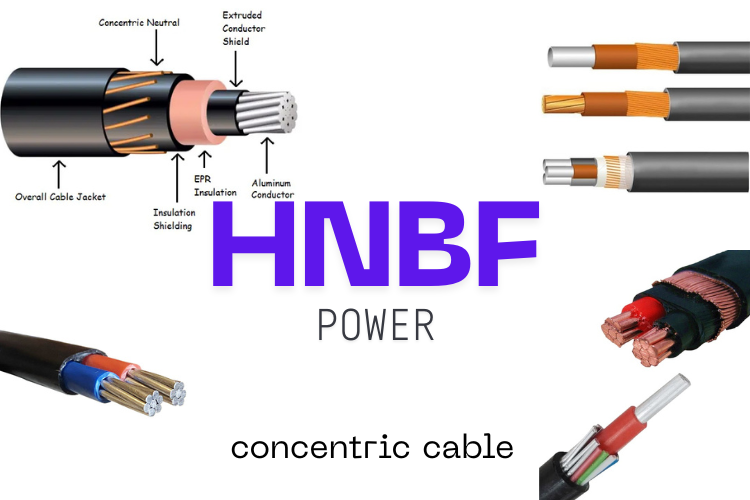
A concentric cable is a power cable in which the phase conductor is placed at the center and surrounded by a layer of concentric conductors usually neutral or grounding wires arranged evenly around the insulated core.
These surrounding wires form a concentric neutral or concentric earth layer, creating a uniform, balanced structure around the main conductor.
Key structural elements
-
Central conductor (copper or aluminum)
-
Primary insulation (commonly XLPE or PVC)
-
Concentric neutral or concentric conductor layer
-
Outer sheath for environmental and mechanical protection
This design delivers both electrical functionality and mechanical integrity, making concentric cable ideal for demanding distribution environments.
Why Concentric Cable Is Widely Used in Utility Distribution
Improved safety and grounding performance
The concentric neutral layer provides a continuous and reliable grounding path. In fault conditions, it helps carry return current safely and reduces step and touch voltage risks an essential requirement for public and industrial distribution networks.
Excellent mechanical balance
Because the neutral wires are evenly distributed around the insulation, concentric cables maintain a circular and balanced profile. This improves resistance to deformation during pulling, bending, and installation.
Compact and installation-friendly design
Compared with separate neutral or earth conductors, concentric cable offers a compact layout. This simplifies trenching, duct installation, and termination work especially in congested urban distribution projects.
Typical Applications of Concentric Cable
Underground distribution networks
Concentric cables are widely installed in:
-
Residential and commercial underground feeders
-
Urban utility distribution systems
-
Industrial power networks
The integrated neutral layer provides stable electrical performance while maintaining physical protection during backfilling and long-term operation.
Service drops and service connections
Utilities frequently use concentric neutral cables for service connections from transformers to customer meters. The design supports safe neutral continuity and simplifies jointing and termination.
Public infrastructure and industrial facilities
Airports, data centers, transportation hubs, and manufacturing plants often specify concentric cable to meet strict grounding and safety standards.
Technical Advantages Engineers Value
Uniform electromagnetic field distribution
The concentric construction produces a more symmetrical electromagnetic field around the cable. This helps reduce external interference and improves overall electrical stability in dense cable routes.
Strong fault current capability
The concentric neutral wires are engineered to carry fault currents for specified durations. This improves network protection coordination and supports reliable system operation under abnormal conditions.
Enhanced durability
The surrounding conductor layer adds mechanical reinforcement to the insulated core, reducing the risk of damage during installation and long-term thermal cycling.
Materials and Construction Options
Conductor materials
Concentric cables are commonly manufactured using:
The concentric neutral layer can also be aluminum or copper, depending on project specifications and utility standards.
Insulation and sheath systems
Modern concentric cable designs typically use:
At HNBF Power, cable constructions are customized to meet international utility standards and project-specific technical requirements.
Concentric Cable vs. Conventional Distribution Cables
Integrated neutral design
Unlike standard single-core or multi-core power cables, concentric cable integrates the neutral directly around the phase conductor. This reduces installation complexity and ensures consistent neutral positioning.
Better fault and grounding control
The continuous concentric layer provides more predictable grounding performance than separate neutral conductors installed in parallel.
Improved mechanical reliability
The symmetrical structure improves bending behavior and pulling strength during installation an advantage on long underground routes and crowded duct banks.
How HNBF Power Supports Utility and EPC Projects
As a global manufacturer of AAC, AAAC, ACSR, ABC, LV power cable and concentric cable solutions, HNBF Power supports power utilities, EPC contractors and infrastructure developers with:
-
Customized concentric cable designs
-
Compliance with IEC, ASTM and utility-specific standards
-
Controlled manufacturing and quality inspection
-
Technical support for specification and project planning
From service drop cables to large-scale underground distribution feeders, HNBF Power delivers consistent product performance that engineers and procurement teams can rely on.
Key Selection Considerations for Procurement Teams
When specifying concentric cable for your project, it is important to evaluate:
-
Conductor size and material based on load and voltage drop
-
Concentric neutral cross-section for fault current capacity
-
Insulation type and temperature rating
-
Mechanical and environmental protection requirements
-
Applicable national and utility standards
Working directly with a qualified manufacturer such as HNBF Power allows project teams to align cable design with both technical and commercial objectives.
Frequently Asked Questions (FAQs)
1. What is the main purpose of the concentric neutral in a concentric cable?
The concentric neutral provides a continuous grounding and return current path, improving fault performance and enhancing operational safety in distribution networks.
2. Is concentric cable suitable for both residential and industrial projects?
Yes. Concentric cable is commonly used in residential service connections, commercial buildings, and industrial power systems due to its safety and mechanical advantages.
3. Can concentric cable be supplied with aluminum conductors?
Absolutely. Many utilities prefer aluminum phase and concentric conductors for cost efficiency and easier handling, especially in large-scale distribution projects.
4. How does concentric cable improve installation efficiency?
The integrated neutral layer eliminates the need for separate grounding conductors, reduces installation steps, and simplifies cable routing and termination.
5. Does HNBF Power provide customized concentric cable designs?
Yes. HNBF Power offers customized conductor sizes, insulation systems, and concentric constructions to meet project-specific and utility-approved standards.
Power Your Distribution Network with HNBF Power
Whether you are upgrading urban distribution systems, developing new residential networks, or planning large industrial facilities, concentric cable offers a reliable and future-ready solution for modern power infrastructure.
Contact HNBF Power today to discuss your project requirements and receive customized concentric cable solutions engineered for your utility and EPC applications.


 English
 Arabic
 French
 Spanish
 Portuguese
 Turkish
 Dutch
Dutch
 Italiano
 Russian
 Romaian
 Portuguese (Brazil)
 Greek
Greek